4 min read
AI and the Future of IR: Why the Most Interpretable Company Wins Capital
The Q4 Insights Team : Published
AI Summary
At the NIRI Capital Area panel on September 16, 2026, in Tysons, Virginia, leaders from IR and capital markets advisory discussed how AI is changing the investor relations role. A key theme was that AI’s value for IR extends beyond productivity into deeper stakeholder relationships and stronger judgment.
As AI shortens the time it takes investors to understand and underwrite a company, the discussion explored what that means for how companies communicate their story and reduce uncertainty for the market.
This article recaps the panel’s main themes, including why interpretability is becoming increasingly important, how IR teams can approach AI adoption at two speeds and why the gap between teams adopting AI and those waiting could continue to grow.
Key takeaways
- Understand why interpretability could influence how investors assess a company
- Learn why judgment and relationships remain valuable skills for IROs in an AI-driven market
- Apply a two-speed adoption approach that pairs quick wins with longer-term strategic sprints
- Recognize why the AI adoption gap between IR teams could continue to widen
Setting the Stage in Tysons
IROs and corporate finance leaders from D.C., Northern Virginia and Bethesda met in Tysons for an evening panel and dinner hosted with NIRI Capital Area. The session was titled “AI and the Future of IR: From Doing More to Creating Real Value.”
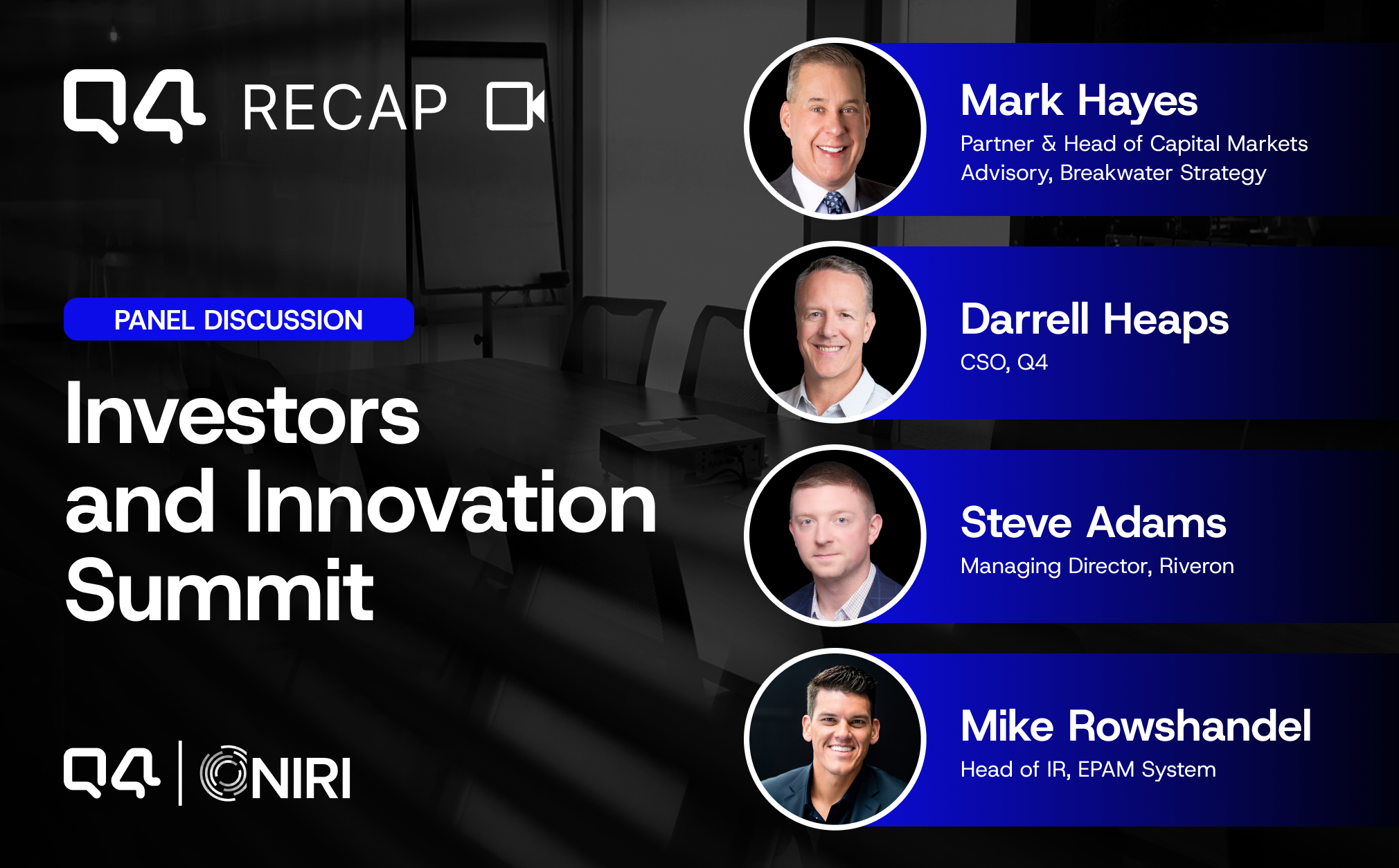
Darrell Heaps, Founder & Chairman of Q4, moderated a discussion with Mark Hayes, Partner & Head of Capital Markets Advisory at Breakwater Capital Markets, Steve Adams, Managing Director at ICR and Mike Rowshandel, Head of Investor Relations at EPAM Systems.
The conversation started with the tools IR teams use today before moving into what teams can do with the time AI gives back, along with what could happen to teams that take longer to adapt.
AI Has Already Changed the IR Role
The panel opened by looking at how quickly AI in IR has moved from early experimentation to everyday use. One point came up throughout the discussion. AI is already changing what boards, management teams and investors expect from the IRO.
Those expectations are rising on several fronts. Boards want sharper insight into how the market views the company. Management teams expect IR to bring forward-looking intelligence into strategic discussions. Investors using AI in their own research expect faster, clearer answers.
As Darrell Heaps put it, “AI’s impact is that the bar of what a good IRO looks like is now much higher.”
Looking ahead to 2027, the panel discussed the risk that IR teams that have not started building AI into their work could become less relevant to the leadership teams they support.
Interpretability Is Becoming More Important
One of the ideas explored during the discussion was how AI could change the way investors consume and assess company information.
As AI becomes part of the research process, how information is structured and communicated takes on greater importance. Companies still need a clear, consistent story, but that story increasingly needs to be understandable to the AI tools investors use as well as the investors themselves.
For IROs, this puts greater focus on interpretability. The easier it is to understand a company’s strategy, performance and outlook, the less ambiguity investors have to work through when assessing it.
Judgment and Relationships Become More Valuable
It is easy to think of AI primarily as a way to do the same IR work faster. The discussion pointed to a bigger opportunity in what IROs can do with the time they get back.
As routine work takes less time, IR teams can put more attention toward the areas where human judgment and relationships matter. That could mean deeper investor conversations, stronger preparation ahead of executive meetings or a closer read on what the Street is asking about.
Mark Hayes connected this shift directly to what leadership expects from IR.
“The key question that we keep getting from boards and management teams is, ‘What’s the quality of the judgment my IRO has?’”
In this environment, the IRO’s role increasingly centers on helping investors understand the company while bringing informed market perspective back to management and the board.
A Two Speed Approach to Adoption
When the conversation turned to getting started, the panel recommended thinking about AI adoption at two speeds.
The first focuses on small, fast wins that improve daily productivity. The second focuses on longer-term strategic sprints, supported by frameworks that keep the team focused on where AI could meaningfully change how IR operates.
Steve Adams pointed to what happens after AI starts freeing up that time.
“If an IRO is just doing that and not finding new ways to add value to the management team or interact with the board, AI becomes the engine for them stalling out in their upward trajectory.”
Panelists emphasized that there is no universal playbook. Every head of IR has to decide what AI adoption looks like for their own team, company and investor base. That includes understanding where AI is genuinely useful rather than applying it to every task simply because it is available.
As Heaps said, “You don’t need AI for every single thing that you’re doing.”
Why the Adoption Gap Keeps Widening
Another theme from the discussion was the growing distance between teams experimenting with AI today and those waiting to get started.
That gap can build over time as teams develop new workflows, learn where AI is most valuable and adjust how they spend their time. The discussion also explored how adoption could shape the way leadership and the board view the IR function.
For teams getting started, the focus does not need to be on using AI everywhere. It is about finding practical applications, learning what works and building from there.
Practical Steps for IROs
Based on the discussion, IR teams can focus on a few priorities for the coming year.
- Pick one or two quick AI wins you can start using this quarter
- Build a longer-term roadmap for how AI could change the way your team operates
- Review your investor communications with interpretability in mind, considering how easily investors and AI tools can understand your story
- Plan how you will use reclaimed time for relationships and strategic insight
- Talk with management and the board about how their expectations for IR are changing
Looking Ahead
AI is changing how IR teams work, but the discussion pointed to a broader shift in where IROs can create value. As routine work takes less time, relationships, judgment and the ability to make a company easier for the market to understand become increasingly important.
For IR teams, the opportunity now is to start finding where AI fits into their work and build from there.
Frequently Asked Questions
What does “interpretability” mean in investor relations?
Interpretability refers to how easily investors, analysts and AI tools can understand a company’s strategy, performance and outlook. As AI becomes a bigger part of investor research, how clearly company information is structured and communicated becomes increasingly important.
Will AI replace investor relations officers?
The discussion focused less on AI replacing the IRO and more on how it changes expectations for the role. As Heaps put it, “The question isn’t, ‘Is AI going to take your job?’ It’s that you can’t do your job without AI.”
How should IR teams start adopting AI?
Start with small, quick wins that improve daily productivity, then pair them with a longer-term plan for how AI could change the way the team operates. Each team should shape its approach around its company and investor base.
Why is there urgency around AI adoption in IR?
The discussion explored how the gap between teams adopting AI and those waiting can grow as early adopters build experience, develop new workflows and learn where AI is most valuable.
Whether you are taking your first steps with AI or building a longer-term strategy, Q4 can help. Connect with our team to see how IR teams are putting AI to work.
Subscribe to our blog.
Get the latest industry insights sent directly to your inbox. Subscribe now.
Content Filter
- Blog (102)
- IR Strategy (31)
- Tech & AI (29)
- Market Intelligence & Targeting (15)
- Earnings & Reporting (14)
- Case Study (10)
- Careers in IR (9)
- IR Websites & Digital Experience (9)
- Events & Webinars (8)
- Solutions & Customer Stories (8)
- Ai (6)
- Security, Governance & Compliance (4)
- Webinar (4)
- Artificial Intelligence (3)