5 min read
Event Recap: Modern Consensus Management at CIRI Senior IRO Leadership Day
Ask any IRO about consensus and you'll hear the same frustration. A group of analysts builds forecasts on your...
5 min read

The conversations at this year’s DIRK Conference reflected a profession at an important turning point.
The conversations at this year’s DIRK Conference reflected a profession at an important turning point.
Under this year’s theme, “Tweet or Trust – IR and the New Complexity,” more than 500 investor relations professionals gathered in Frankfurt to discuss how the role continues to expand. Across sessions covering AI, shareholder activism, investor engagement, governance and market transparency, one challenge surfaced repeatedly. IR teams are being asked to deliver greater strategic value while navigating increasing complexity with the same lean resources.
That challenge set the stage for Q4’s fireside session, From Reactive to Agent-Led. The New Standard for Global Results Execution, where Q4 Founder and Chief Strategy Officer Darrell Heaps was joined by Laura Hecker, Executive Director of Investor Relations at flatexDEGIRO SE. Together, they explored how AI is changing the way investor relations teams prepare for results, engage investors, and support executive decision making.
For many teams, every results cycle follows a familiar pattern and preparing for results requires significant coordination across people and systems. Before strategic conversations can begin, IROs often spend valuable time pulling together information from multiple sources, leaving less time to advise leadership and shape the narrative.
During the session, attendees were asked where the greatest amount of manual effort exists during the results cycle. Nearly 40% selected “all of the above,” highlighting that teams continue to spend significant time collecting internal data, analyzing peer activity, building executive narratives and preparing Q&A.
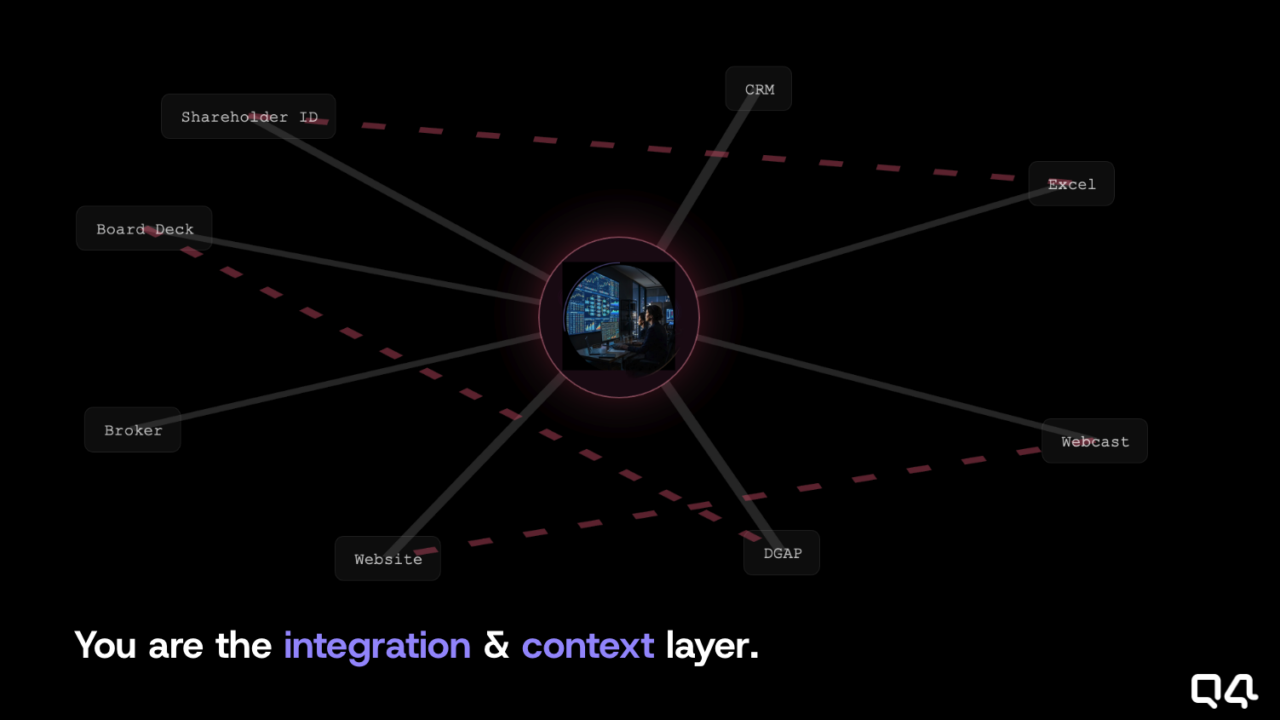
As Heaps explained, “You are the integration layer.” Across websites, disclosure platforms, CRM systems, shareholder intelligence tools, analyst models and peer research, IROs are often responsible for connecting information that lives across multiple systems before strategic decisions can even begin.
Hecker reinforced this reality during the discussion, describing how today’s results process still requires IR teams to work across multiple systems while balancing analyst engagement, executive preparation, and regulatory requirements throughout the reporting cycle.
Much of today’s AI requires users to know what to ask before any work begins; It waits for a prompt.
Agent-led workflows take a different approach. Rather than responding after someone asks a question, agents work continuously in the background. They monitor market developments, analyze changes in analyst sentiment, identify emerging risks, prepare executive materials and surface what deserves attention before an results meeting or investor call ever begins.
The role of the IRO becomes more strategic.
Instead of spending hours gathering information, teams can spend more time interpreting insights and advising leadership to strengthen investor relationships.
As Heaps put it, “We’re automating the admin. To give you back the job.”
One of the themes throughout the session was shifting preparation from a quarterly event to an ongoing process.
Rather than compressing weeks of work into the days leading up to results, agent-led workflows help teams stay prepared throughout the quarter. That includes monitoring peer announcements and analyst commentary, identifying shifts in consensus expectations, highlighting potential narrative risks before the quiet period begins and helping leadership prepare for the questions that are most likely to come from investors.
The audience poll reflected this opportunity for improvement. More than half of attendees said executive leadership is typically not aligned on key messaging and potential risk areas until the final preparation phase, leaving limited time to address emerging issues before results day.
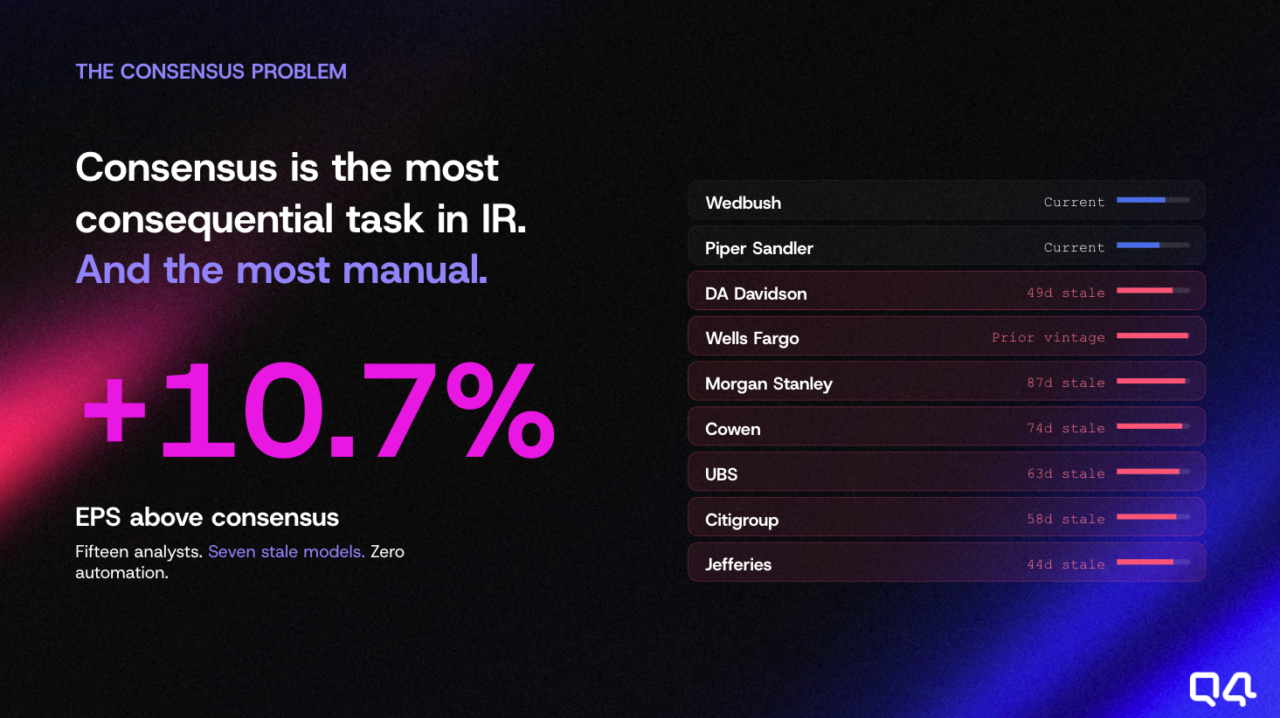
A significant portion of the session focused on one of the most time-intensive parts of the results cycle, consensus management.
Managing analyst models, identifying stale assumptions, preparing analyst-specific talking points and responding to post-results questions remain highly manual processes for many IR teams.
During the fireside discussion, Heaps demonstrated how Q by Q4, the IRO Agent™ on the Q4 Platform™, supports a more connected approach to consensus management. By combining consensus data with AI-driven analysis, the workflow helps teams identify meaningful variances, surface emerging trends, prepare compliant analyst talking points and prioritise follow-up conversations after results.
Hecker shared how this type of workflow could reduce the manual effort that typically follows an results announcement, allowing teams to spend less time assembling information and more time engaging analysts and advising leadership.
The audience largely agreed on where automation could create the greatest impact. Forty-four percent said autonomous agents would deliver the most value by handling the labor-intensive groundwork, while another 33% pointed to predictive Q&A and narrative preparation.
Another important distinction from the discussion was the role of human oversight.
Investor relations remains one of the most strategic and highly regulated functions within a public company. Judgment and experience cannot be automated.
The greatest opportunity for AI lies elsewhere.
By reducing repetitive manual work and surfacing relevant intelligence before it reaches the IRO, teams have more capacity to focus on the conversations and decisions that create value.
Heaps summed up the shift in one sentence.
Investor relations has always been built on trust and strong relationships. Those responsibilities remain at the center of the role. What is changing is the technology that supports them, giving teams better visibility, stronger intelligence and more time to focus on strategic work.
As expectations continue to grow, organizations that invest in more connected, intelligence-driven workflows will be better positioned to prepare for results, navigate changing market conditions and support executive decision making with confidence.
Consensus management remains one of the most manual parts of the results process, making it one of the biggest opportunities for modernization.
Our Modern Consensus Management Buyer’s Guide explores how leading IR teams are replacing spreadsheet-heavy workflows with a more connected approach to market intelligence, helping them prepare for results with greater confidence and stronger visibility into analyst expectations.
Download the guide to learn what a modern consensus management strategy looks like.