 Oskar Yasar
Planning a Successful IRO Event
Planning a Successful IRO Event - Q4 Blog

In this guest article for Q4, Oskar Yasar, Managing Partner at Broome Yasar, explores how the profession is evolving, the forces reshaping its future and what they mean for the next generation of IR leaders. Yasar shares key insights from his book, The Global Investor Relations Revolution, drawing on one of the largest studies of investor relations professionals conducted to date.
Investor relations stands at one of the most significant moments in its history.
Drawing on research conducted for The Global Investor Relations Revolution, which surveyed more than 1,000 investor relations leaders, association heads, CEOs, CFOs, advisers and capital markets participants across five continents, this article explores how the role of investor relations has evolved from a communications function into a strategic business discipline.
The research reveals a profession that is more influential, more sophisticated and more deeply embedded in corporate decision-making than at any point in its history. It also highlights the forces reshaping investor relations, from shareholder activism and artificial intelligence to evolving investor expectations and increasingly complex capital markets.
A Profession Transformed
One of the clearest conclusions from the study is that investor relations has undergone one of the most dramatic evolutions of any corporate function.
Over the past 70 years, IR has continually reinvented itself. What began as a shareholder communications discipline evolved into a public relations function, then a financial reporting role, before becoming the strategic advisory profession we know today. Throughout that journey, the profession has repeatedly adapted to changing investor expectations, regulatory demands and market realities.
Today, leading investor relations professionals are no longer simply responsible for explaining quarterly results. They are helping shape corporate strategy, advising CEOs and boards, managing reputation, identifying emerging risks, providing market intelligence and acting as trusted intermediaries between companies and the capital markets.
This transformation has fundamentally changed how the profession is viewed. In many of the world's leading companies, the IRO has become a key strategic adviser, providing insights that directly influence executive decision-making. Increasingly, boards and management teams are seeking the IRO's perspective before decisions are made, rather than simply relying on them to communicate decisions afterwards.
The Tectonic Shifts Reshaping Investor Relations
The study identified several major forces that are reshaping the future of investor relations.
The first is the continued rise of shareholder activism. Activist campaigns are becoming more sophisticated, more frequent and more global. Companies today face scrutiny not only over financial performance but also governance, capital allocation, sustainability and strategic direction. As a result, investor relations has become a critical component of risk management and shareholder engagement.
The second is the decline in publicly listed companies across many developed markets. With fewer companies competing for investor attention, expectations around transparency, communication and market engagement have increased significantly. This trend is placing greater emphasis on the value that high-quality investor relations can create.
The third is the continued growth of passive investing and algorithmic trading. Increasingly, investment decisions are being driven by data, indices and quantitative models rather than traditional company interactions. This requires investor relations teams to understand not only investors but also the screening methodologies, data providers and market structures that influence capital allocation decisions.
The fourth is the ongoing expansion of sustainability, ESG and corporate purpose considerations. Regardless of political cycles or shifting terminology, investors increasingly want to understand how companies create long-term value, manage risk and position themselves for future growth. Conversations that were once dominated by earnings and guidance now regularly encompass culture, governance, innovation, talent, supply chains and sustainability.
Finally, there is artificial intelligence.
While much attention has focused on the disruptive potential of AI, the study suggests it may ultimately elevate rather than diminish the role of investor relations. Reporting processes, sentiment analysis, investor targeting and data management will increasingly be automated. However, the skills that will matter most in the future, judgement, strategic insight, relationship management and leadership, remain fundamentally human.
The Rise of the Executive IRO
One of the most important conclusions from the study is the emergence of what might be described as the "Executive IRO."
As technology automates routine tasks and markets become more complex, the future IRO will require a unique combination of skills. Financial expertise alone will no longer be sufficient. Nor will communications expertise in isolation.
The next generation of leaders will need to combine the analytical capabilities of a finance professional, the strategic thinking of a corporate strategist, the communication skills of a senior corporate affairs executive and the commercial judgement of a business leader.
This evolution is already underway. Around the world, increasing numbers of senior IROs are moving into broader leadership positions including strategy, corporate development, CFO roles and, in some cases, CEO positions. Investor relations is becoming recognised as one of the strongest executive training grounds within modern corporations because it sits at the intersection of finance, strategy, governance, reputation and stakeholder management.
Priorities for the Profession
The study also highlights several priorities if investor relations is to continue its upward trajectory.
First, the profession must continue to professionalise globally. While some markets have highly developed IR ecosystems, others remain at earlier stages of maturity. Greater collaboration between associations, wider adoption of professional qualifications and a stronger global exchange of best practices will help raise standards across the industry.
Second, investor relations must strengthen its collective voice. Despite its growing importance, many practitioners still operate in relatively small teams and often in isolation. A stronger sense of global identity and shared purpose will be essential if the profession is to maximise its influence.
Third, the industry must embrace technological change. AI, advanced analytics and digital engagement tools should be viewed as enablers that allow investor relations professionals to focus on higher-value strategic activities rather than administrative processes.
Fourth, IROs must continue broadening their business capabilities. Understanding geopolitics, sustainability, regulation, technology, reputation and operations will increasingly differentiate the strongest practitioners from the rest of the field.
Finally, investor relations professionals must continue earning their place at the leadership table. The profession's future growth will depend not on what it communicates, but on the strategic value it contributes to corporate decision-making.
A Profession with an Extraordinary Future
Perhaps the most encouraging conclusion from the study is the optimism that exists across the global investor relations community.
Throughout its history, investor relations has repeatedly demonstrated an extraordinary ability to adapt. Every major disruption that has challenged the profession has ultimately strengthened it. From regulatory reform and market crises to technological transformation and changing investor expectations, IR has consistently evolved to meet the demands of a new era.
Today, investor relations is more influential than at any point in its history. It is more strategically important than ever before. It is increasingly recognised as a trusted adviser to management teams, boards and investors alike.
The Global IR Revolution is not simply a story about how far the profession has come. It is a blueprint for where it is going next.
And if the past seven decades have demonstrated anything, it is that the most exciting chapter in the evolution of investor relations may still lie ahead.
About Oskar Yasar: Oskar Yasar is Managing Partner at Broome Yasar and author of the Amazon bestselling The Global Investor Relations Revolution. To learn more about his research and publications, visit Broome Yasar.
Get the latest industry insights sent directly to your inbox. Subscribe now.

Planning a Successful IRO Event - Q4 Blog
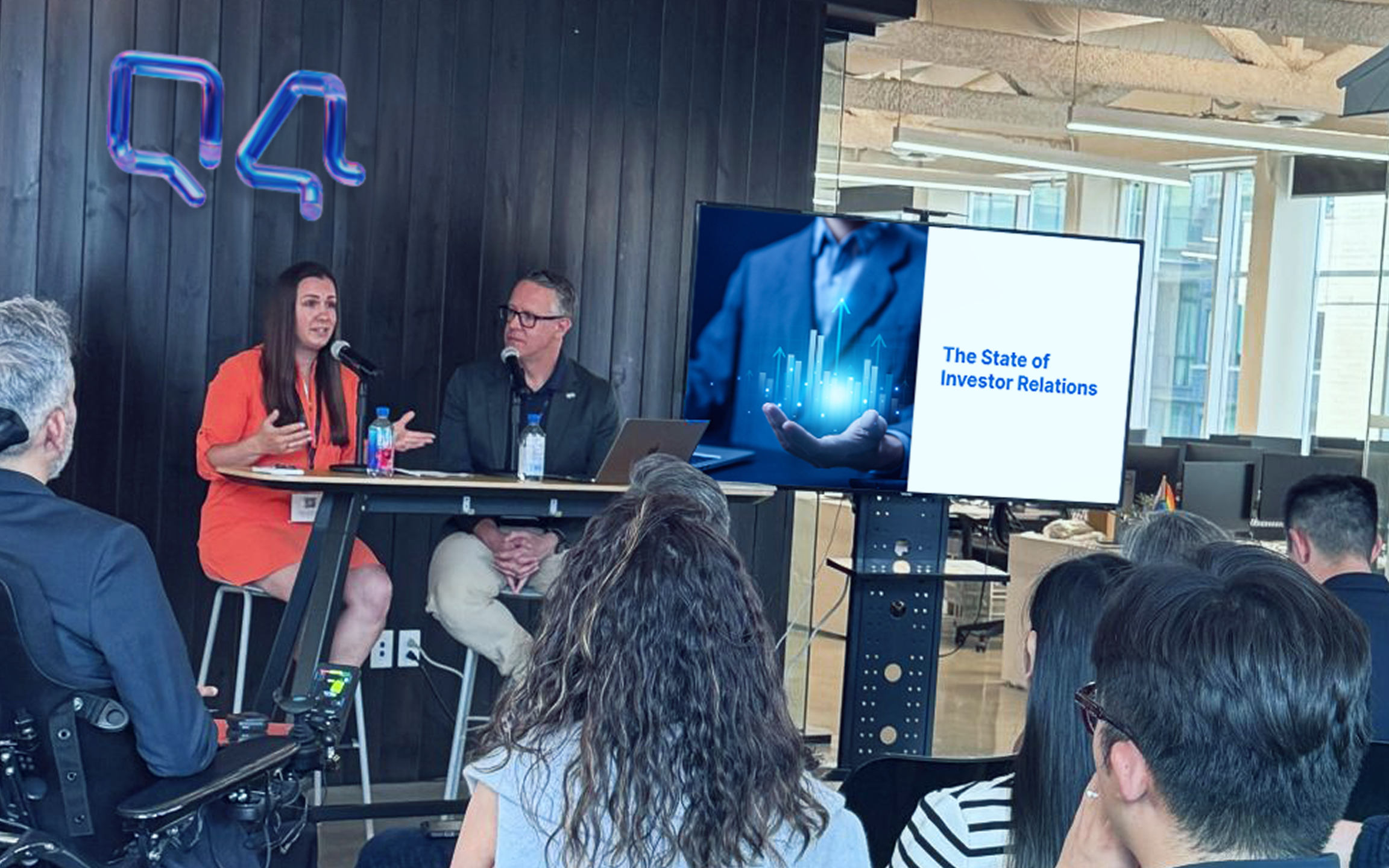
At Q4’s recent IR Masterclass: Leveraging AI & Tech for Success, IR professionals gathered at the Toronto office…

IR Ops Software, like the Q4 Platform, gives you a single, integrated solution designed to streamline workflows, enhance data visibility, and provide...